Intelligent Agents & Environments- A Game AI Showcase
A curated collection of Unity and C# mini-projects demonstrating practical implementations of core Game AI techniques, ranging from heuristic pathfinding and state-driven behavior to procedural terrain generation.
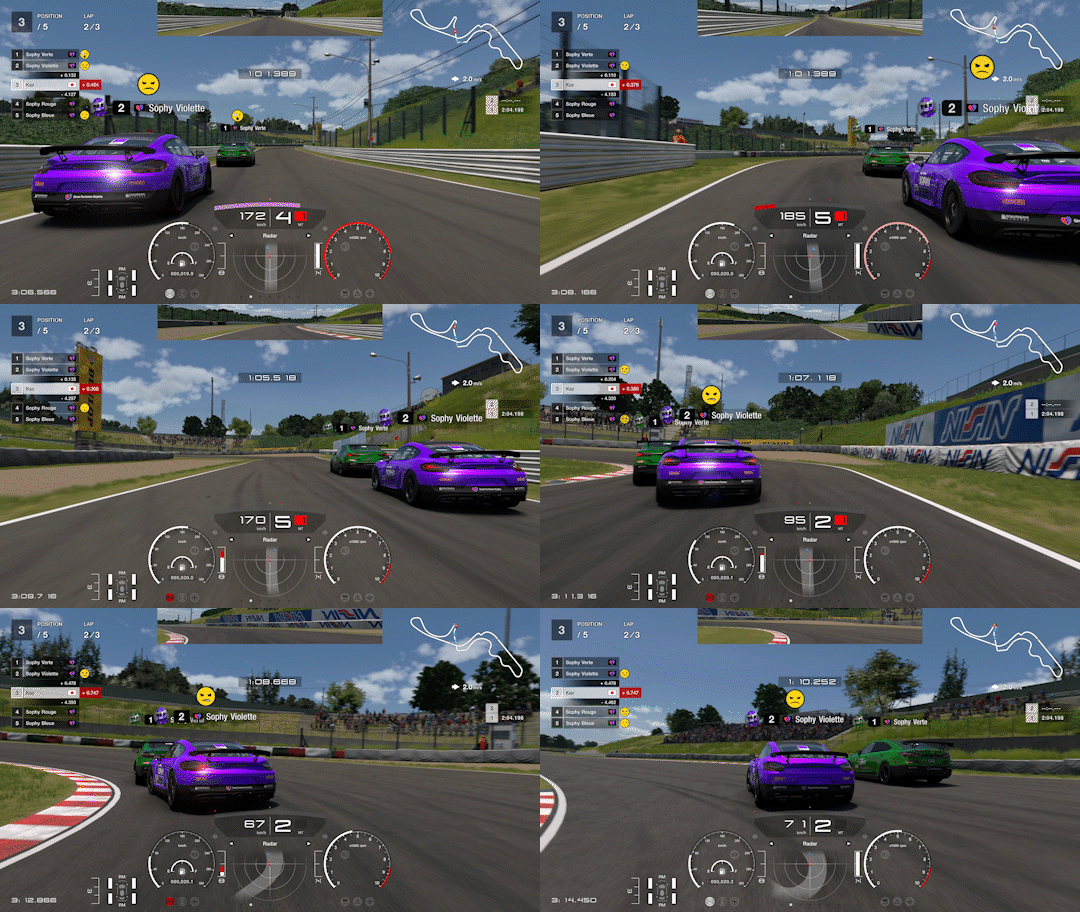
This collection showcases a series of advanced algorithms and systems developed for artificial intelligence in interactive environments. Each project focuses on a distinct domain of game AI, from spatial representation and heuristic search to autonomous decision-making and procedural content generation.
1. Grid Lattice Navigation
Developed a 2D grid lattice system within a game engine to map continuous environments into discretized, navigable cells. Engineered precise Axis-Aligned Bounding Box (AABB) overlap tests and implemented the shrink method to evaluate traversability, guaranteeing mathematically sound obstacle avoidance for dynamic agents.
2. Continuous Path Network Generation
Engineered a Path Network system facilitating continuous-space pathfinding. Algorithmically plotted graph nodes and generated valid, bidirectional path edges by applying Points of Visibility algorithms. Integrated continuous raycast-based occlusion checks ensuring generated agent paths maintained safe clearances from static terrain geometry.
3. Incremental A* (A-Star) Search
Implemented a highly optimized, incremental A* pathfinding algorithm designed to distribute computational load across multiple game loop ticks, preventing framerate drops. Engineered both Manhattan and Euclidean heuristic functions and integrated a robust fallback mechanism returning paths to the closest reachable node when an absolute goal is obstructed. The modular architecture natively supports variants like Dijkstra’s Algorithm and Greedy Best-First Search.
4. Navigation Mesh (NavMesh) Construction
Programmed a custom NavMesh generator to segment complex navigable terrain into optimized, obstacle-free convex polygons. Extracted a highly efficient spatial graph by calculating the midpoints of adjacent portal edges, drastically reducing the pathfinding query overhead compared to traditional uniform grid lattices.
5. Ballistic Trajectory Prediction & Kinematics
Developed an advanced predictive targeting system applying kinematic physics to calculate 3D ballistic trajectories for intercepting dynamically moving targets. Utilized mathematical models including Millington’s static targeting, the Law of Cosines, and iterative refinement algorithms. Integrated intelligent shot-selection logic evaluating target velocity, interception time, and environmental occlusion using real-time physics raycasts.
6. Hierarchical Finite State Machine (FSM)
Architected a robust Finite State Machine controlling autonomous agents in a competitive, team-based sports simulation. Programmed complex, context-aware states managing evasion, targeting, and dynamic objective collection. Implemented advanced team coordination behaviors utilizing a shared blackboard architecture (TeamShare) to optimize multi-agent strategies and prevent redundant tactical actions.
7. Fuzzy Logic Autonomous Vehicle Controller
Designed a continuous Fuzzy Logic inference system to pilot an autonomous physics-based racecar along procedurally generated tracks. Authored custom fuzzy rule sets, defined precise membership functions, and utilized mathematical defuzzification to calculate smooth, real-time steering and throttle responses. The control system dynamically processed geometric and kinematic variables including track curvature, vehicle speed, and spatial lookahead vectors.
8. Procedural Terrain Generation (PCG)
Constructed a Procedural Content Generation tool utilizing multi-octave Perlin Noise and gradient noise mapping to create expansive 3D heightmap terrains. Engineered custom bandpass rules, trapezoid functions, and mathematical mapping curves to cleanly segment and seamlessly crossfade distinct geological biomes (e.g., mountain ranges, sand dunes). The deterministic generation rules were serialized into highly modular ScriptableObjects.